Christian Hirsch

Christian Hirsch

Professor of Stochastics and Its Applications

University of Göttingen

Christian Hirsch

Since October 2026, I have been Professor of Stochastics and Its Applications at the University of Göttingen, where I am based at the Institute for Mathematical Stochastics. My research focuses on stochastic geometry, spatial random networks, large deviations, and the statistical foundations of topological data analysis. I am also interested in stochastic models of learning and applications in biology, physics, and data science.

Previously, I was Associate Professor of Statistics and Data Science at Aarhus University. Before that, I was Assistant Professor at the University of Groningen and the University of Mannheim. I held postdoctoral positions at Aalborg University, LMU Munich, and WIAS Berlin. I received my PhD from Ulm University.

Save the date, 2–6 August 2027. Aarhus summer school on Hidden Information in Data: Topology, Inference, and Learning. Details to follow.

Interests

  • Statistical foundations of topological data analysis
  • Large deviations theory in stochastic geometry
  • Percolation theory of spatial random networks
Projects

Topological data analysis

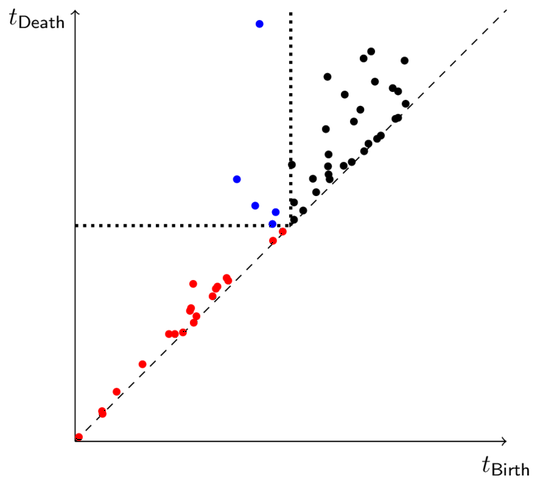
Many modern data sets have an underlying shape. Clusters, loops, branches, voids, or higher-order structures that are not visible from standard summaries alone. Topological data analysis provides mathematical tools for detecting such structure and studying how robust it is under noise. My work develops probabilistic limit theorems and statistical methods that help turn these topological summaries into reliable quantitative tools.

Large deviations

Random systems usually behave in a typical way, but the rare exceptions are often the most informative. Large deviation theory asks how unlikely events occur and what their most likely mechanisms are. In spatial probability, this leads to questions such as whether an unusually dense network is caused by a global change in the system or by a small localized anomaly. My work studies such rare-event mechanisms in geometric and network-based models.

Spatial random networks

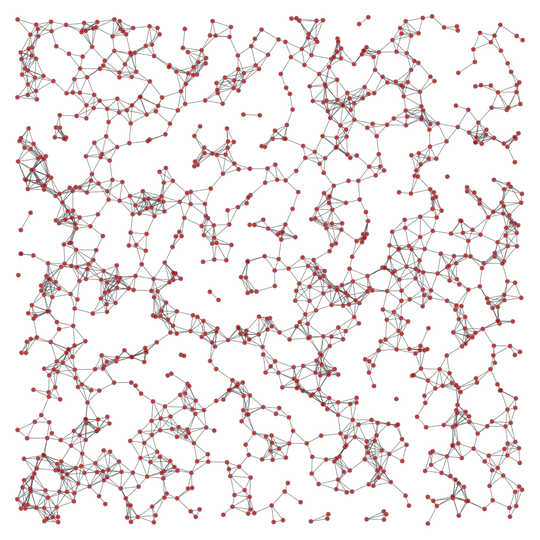
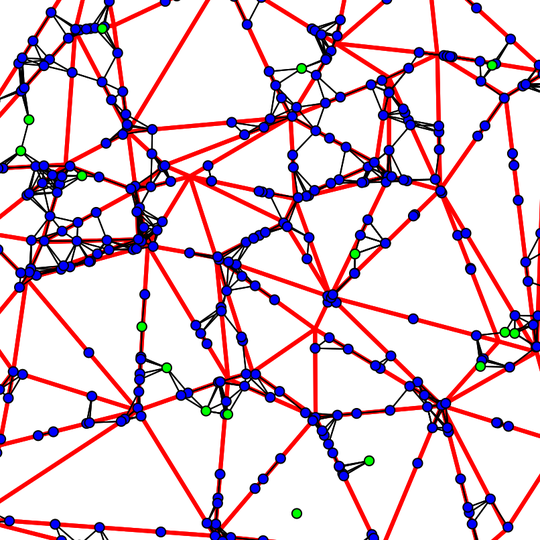
Many networks are shaped by geometry. Neurons, particles, wireless devices, social contacts, or biological structures are not connected in an abstract space, but through spatial constraints and local interactions. Spatial random networks combine ideas from probability, geometry and statistical physics to model such systems. My research studies how connectivity, spreading, clustering and large-scale behavior emerge from local spatial rules.

Teaching

Supervision

  • Postdocs
  • PhD theses
    • C. Duan (08/25-). Large-deviation analysis of interacting particles
    • N.N. Lundbye (02/23-). Statistical foundations of TDA
    • P. Juhasz (11/22 - 12/25). TDA-based models of evolving higher-order networks
    • D. Willhalm (05/20 - 04/24). Limit theory for spatial random networks. Now, Machine Learning Scientist at Layer 6.
  • MSc theses
    • C. Perch (06/25). Monte Carlo Methods and Importance Sampling Techniques for Forecasting Macroeconomic Risks
    • R.H. Nielsen (06/25). Analyzing the Simulation of Semistationary Processes
    • M.H. Petersen-Westergaard (06/25). Efficient Monte Carlo Methods for Estimating Nonlinear Financial Models
    • L. de Jonge (07/21). Absence of WARM percolation on geometric networks. Completed PhD degree at the University of Osnabrück.
    • Y. Couzinié (09/18). Sublinearly reinforced Pólya urns on graphs of bounded degree. Now, Postdoc at the Tokyo Institute of Technology.
    • F. Rudiger (09/18). Recurrence and transience of graphs generated by point processes
    • A. Hinojosa Calleja (08/16). Interference in ad-hoc telecommunication systems in the high-density limit. Completed PhD degree at the Universitat de Barcelona.
    • E. Rolly (06/16). Gibbs-Masse für Trajektorien von Nachrichten in einem Kommunikationsnetzwerk
    • A. Tóbiás (04/16). Highly dense mobile communication networks with random fadings. Now, Assistant Professor at Budapest University of Technology.
  • BSc theses
    • D.H. Groth and V.S. Bergenser (06/26). Premium Control in a Mutual Insurance Company
    • T. Sørensen (06/26). High-resolution mesh generation from sparse point clouds
    • O.E. Bech and E.J. Elberg (06/25). Improving Coronary artery segmentation for tachycardia patient
    • J.S. Knudsen and F. Nordberg (06/25). Prediction of coronary artery calcification in breast cancer radiotherapy CT-scan
    • C.D. Fuglkjær and M. Fridorf (06/25). Federated learning with applications in dentistry
    • K.B. Bräuner and A. Kristensen (05/24). Forudgående tidsbestilling for patienter
    • J. Borg (05/24). Markov beslutningsteori: Optimal opladning af elbiler
    • A.P. Diakovasilis and L.V. Jacobsen (05/24). Optimal ambulanceudsendelse
    • M.-C. Mociran (05/24). Optimering af blodplader oplagring
    • F. Tækker (05/24). Screening og behandling af kroniske sygdomme
    • C. Teoridis (05/24). Optimal tildeling af forespørgsler blandt tradløse sensornetværk og databaser
    • C.S. Pallesen (05/24). Forudgående patientkonsultationsplanlægning
    • H.C. Hansen (01/24). Convex hull algorithms for the triangulation/construction of alpha complexes
    • B.H. Kristensen (06/23). Asymptotic normality of tessellation - based persistent Betti numbers
    • B. Buttenschøn (06/23). A law of large numbers for wide one-layer neural networks
    • F. Brück (06/17). Percolation properties of Poisson graphs. Completed PhD at the TU Munich.
    • L. Kriouar (07/21). Analysis of financial data with time series and persistent homology
    • H. Hong (07/21). Geometric and topological approaches to mode clustering
    • J. Langenbahn (12/19). Konvergenz des Pseudo-Marginalen MCMC Verfahren
    • H. Blocher (02/18). Poisson Matching. Now, PhD student at LMU Munich.

Contact