Abstract
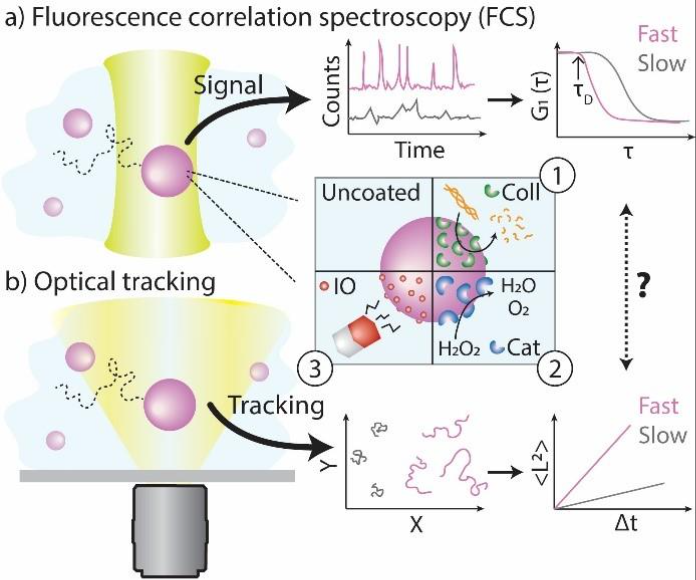
Active colloids (also known as motors, swimmers) have attracted enormous attention in the past two decades. The field has evolved rapidly resulting in diverse motor designs used to navigate in different environments. However, the question of the extent to which 2D and 3D analysis methods can be directly compared remains challenging. Here, we relate the motion of 200-nm particles when assessed by fluorescence correlation spectroscopy (FCS) in a 3D volume to the standard optical microscopy-based tracking method in 2D. We select three types of motors that exemplify different common mechanisms of propulsion, i.e., self-diffusiophoresis, bubble propulsion and magnetic guidance. We systematically assess the minimum requirements of colloids to be detectable in an FCS setup and use the most suitable conditions to evaluate the locomotion of single or mixed populations of motors. The results suggest that in addition to quantitatively reproducing the motor mobility assessment by optical tracking, FCS allows for accurately quantifying the mobility of motors below the resolution limit of (standard) optical microscopes provided that appropriate data treatment and evaluation procedures are applied. Taken together, FCS and optical tracking are complementary methods to determine the diffusivity values of the entire particle population and the individual motors, respectively, allowing for a detailed exploration of motion.